συνταξη
What Is Syntax and Why It Mattersσυνταξη
Syntax is one of those concepts that quietly shapes everything we say and write, yet most people rarely think about it directly. At its core, syntax refers to the way words are arranged to form meaningful sentences. It’s not just about grammar rules—it’s about structure, clarity, and communication. Without syntax, language would be chaotic, and even simple ideas would be difficult to express.
In everyday life, we rely on syntax constantly. Whether you’re sending a quick text message, writing an email, or having a conversation, you are applying syntactic rules—even if unconsciously.συνταξη The way you structure your sentences determines how clearly your message is understood. A well-constructed sentence can convey complex ideas effortlessly, while a poorly structured one can confuse or mislead.
Beyond clarity, syntax also influences perception. People often judge the quality of writing—and even the credibility of the writer—based on sentence structure. Clear, well-organized sentences suggest confidence and expertise, while awkward or incorrect syntax can undermine the message, no matter how good the idea behind it is.
The Fundamental Elements of Syntaxσυνταξη
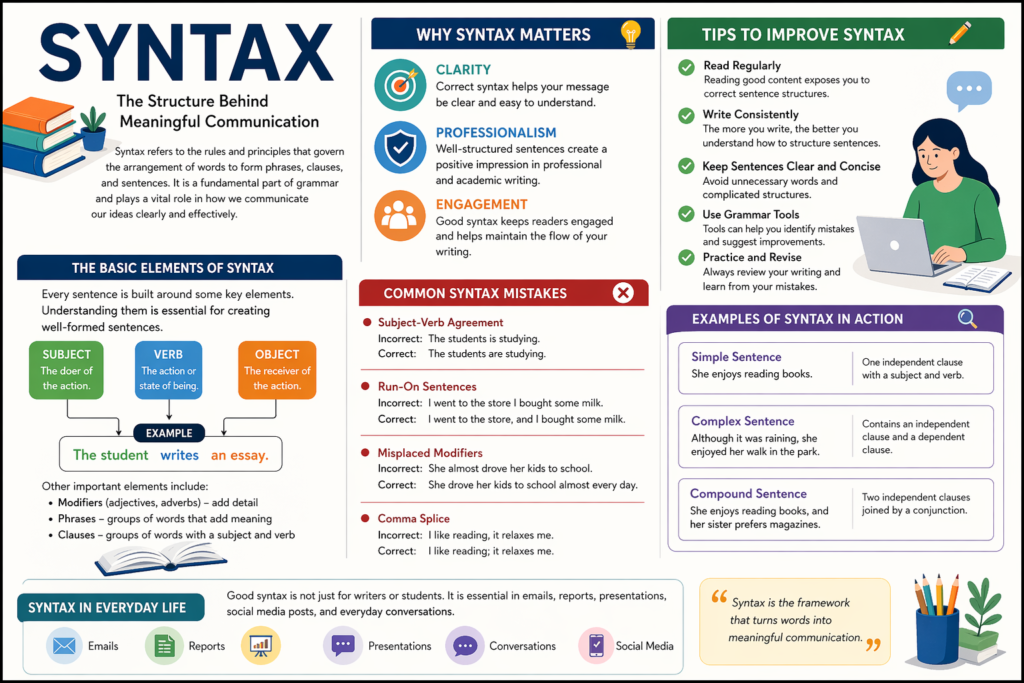
To understand syntax, it’s helpful to break it down into its core components. Every sentence typically revolves around three main elements: the subject, the verb, and the object. These form the backbone of sentence construction and give meaning to our thoughts.
The subject is the doer of the action, the verb expresses the action itself, and the object receives that action. For example, in the sentence “The student writes an essay,” “the student” is the subject, “writes” is the verb, and “an essay” is the object. This simple structure forms the basis of countless sentences across languages.
However, syntax doesn’t stop there. Additional elements such as modifiers, phrases, and clauses enrich sentences and provide more detail. Adjectives describe nouns, adverbs modify verbs, and clauses add layers of meaning. Together, these components allow language to be flexible, expressive, and precise.
Syntax in the English Language
English syntax tends to follow a relatively fixed word order compared to some other languages. The typical structure is Subject-Verb-Object (SVO), which helps maintain clarity. For instance, “She reads books” follows a predictable pattern that makes it easy to understand.συνταξη
Unlike more flexible languages, changing the word order in English can significantly alter meaning or make a sentence incorrect. For example, “Books reads she” sounds unnatural and confusing. This rigidity means that mastering word order is especially important for clear communication in English.
That said, English still allows some variation for emphasis or stylistic purposes. Writers and speakers can rearrange elements to highlight certain ideas or create a particular tone. Understanding these variations can help you become more expressive and effective in your communication.
The Role of Syntax in Written Communication
When it comes to writing, syntax plays a critical role in readability and engagement. A well-structured sentence guides the reader smoothly from one idea to the next, making the content easier to follow. Poor syntax, on the other hand, can interrupt the flow and make even simple ideas seem complicated.
In professional and academic contexts, good syntax is essential. Whether you’re writing a report, an essay, or a business email, clarity and precision are key. Readers expect information to be presented logically, and syntax is what makes that possible.συνταξη
Additionally, strong syntax contributes to the overall tone of a piece. Short, direct sentences can create a sense of urgency or clarity, while longer, more complex sentences can add depth and sophistication. Knowing how to balance these styles is an important skill for any writer.
Common Syntax Mistakes and How to Avoid Them
Even experienced writers make syntax mistakes from time to time. One of the most common errors is subject-verb agreement. For example, saying “The group of students are studying” can be incorrect depending on context, as “group” is singular.συνταξη
Another frequent issue is run-on sentences. These occur when multiple ideas are combined into one long sentence without proper punctuation or structure. While complex sentences are useful, they should still be clear and easy to follow.
Word placement is another area where mistakes often happen. Misplacing a modifier can completely change the meaning of a sentence. For example, “She almost drove her kids to school every day” suggests she didn’t actually do it, whereas “She drove her kids to school almost every day” conveys a very different meaning.
The key to avoiding these mistakes is simple: revise your work. Reading your sentences out loud can help you spot awkward phrasing or confusion.
Syntax in Spoken Languageσυνταξη
In spoken language, syntax tends to be more flexible and less formal than in writing. People often use shorter sentences, omit certain words, or rely on tone and context to convey meaning. This makes conversations more natural and fluid.συνταξη
However, basic syntactic structure still matters. If a sentence is too disorganized, the listener may struggle to understand it. Clear sentence construction helps ensure that your message is received as intended.
Good syntax in speech also boosts confidence. When you speak in a structured and organized way, you come across as more knowledgeable and persuasive. This is especially important in presentations, interviews, and professional discussions.συνταξη
How to Improve Your Syntax Skills
Improving your syntax doesn’t require complicated techniques—it’s mostly about consistent practice and awareness. One of the best ways to develop better syntax is by reading high-quality content. Books, articles, and well-written blogs expose you to effective sentence structures.
Writing regularly is equally important. The more you practice, the more natural good syntax becomes. Try experimenting with different sentence lengths and styles to see what works best for your message.
Feedback is another powerful tool. Having someone review your writing can help you identify patterns of mistakes that you might not notice on your own. Over time, this awareness leads to improvement.
You can also use grammar-checking tools to catch errors and refine your writing. While these tools aren’t perfect, they can be very helpful for learning and editing.συνταξη
The Importance of Syntax in Educationσυνταξη
Syntax plays a foundational role in education, particularly in language learning. Students are taught how to construct sentences correctly so they can communicate their ideas clearly and effectively.
Learning syntax is not just about memorizing rules—it’s about understanding how language works. Through practice and application, students develop the ability to express complex thoughts in a structured way.
Strong syntax skills also benefit other subjects. Whether it’s writing an essay in history or explaining a concept in science, clear sentence structure helps students present their ideas more effectively.
Syntax in the Digital Age
In today’s digital world, syntax is more important than ever. With the rise of emails, social media, and instant messaging, written communication has become a central part of daily life.
While digital communication often encourages speed and brevity, clarity should not be sacrificed. A poorly written message can lead to misunderstandings or create a negative impression.
At the same time, technology has made it easier to improve syntax. Tools like spell checkers, grammar assistants, and AI writing platforms help users refine their writing and avoid common mistakes.
Conclusionσυνταξη
Syntax is far more than just a set of rules—it’s the framework that allows us to communicate effectively. It shapes how we express ideas,συνταξη how others understand us, and how our words are perceived.
By paying attention to sentence structure and practicing regularly, anyone can improve their syntax. It’s not about perfection, but about clarity and effectiveness.
In the end, strong syntax turns simple thoughts into powerful communication. Whether you’re writing or speaking, mastering syntax is a skill that will benefit you in every aspect of life.