sri lanka people indian
Sri Lanka and Its People
When you look at Sri Lanka on a map, it might appear as a small island just south of India, but its cultural and historical depth is anything but small. The people of Sri Lanka represent a fascinating blend of ethnicities, sri lanka people indian languages, and traditions shaped by centuries of interaction with neighboring India and other parts of the world. This connection is not superficial—it runs deep through history, religion, language, and even everyday lifestyle.
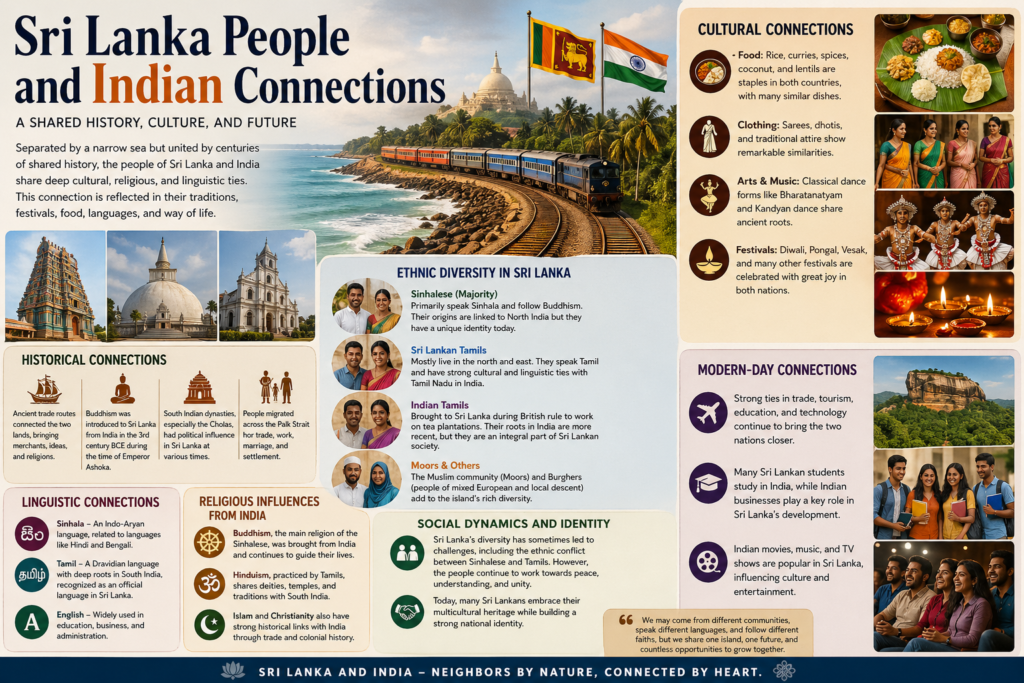
Sri Lanka’s population is primarily composed of several ethnic groups, including the Sinhalese, Sri Lankan Tamils, and Indian Tamils, along with smaller communities such as the Moors and Burghers. Each group has its own identity, yet they are all tied together through shared spaces, historical narratives, and regional influences—especially those coming from India.
The relationship between Sri Lanka and India is one of proximity and continuity. The narrow stretch of water known as the Palk Strait separates the two, but historically, this has been more of a bridge than a barrier. Over thousands of years, people, ideas, religions, and trade have moved freely across this space, creating a cultural overlap that still exists today.
Understanding Sri Lankan people without acknowledging Indian influence would be incomplete. From religious beliefs to linguistic roots, from cuisine to traditional attire, Indian elements are embedded in Sri Lankan society. However, Sri Lanka has also developed its own distinct identity, making it a unique cultural entity rather than just an extension of India.
Historical Connections Between Sri Lanka and India
The history of Sri Lanka is deeply intertwined with that of India. Ancient chronicles such as the Mahavamsa describe the arrival of Prince Vijaya from northern India, which is often considered the beginning of the Sinhalese civilization. While historians debate the accuracy of these accounts, they clearly reflect the longstanding narrative of Indian origins in Sri Lankan history.
Trade between the island and the Indian subcontinent dates back thousands of years. Merchants traveled across the Palk Strait, exchanging goods like spices, textiles, and precious stones. This trade was not just economic—it also facilitated the exchange of ideas, customs, and religious practices. Indian traders and settlers played a crucial role in shaping Sri Lanka’s early urban centers and social structures.
Religion is perhaps the most significant area where Indian influence is evident. Buddhism was introduced to Sri Lanka from India during the reign of Emperor Ashoka in the 3rd century BCE. His son Mahinda is said to have brought Buddhism to the island, leading to its establishment as the dominant religion among the Sinhalese. This religious connection continues to shape Sri Lankan identity to this day.
At the same time, South Indian kingdoms, particularly the Chola Dynasty, exerted political influence over parts of Sri Lanka at various times. These invasions and settlements contributed to the presence of Tamil communities on the island, further strengthening the Indian connection.
Ethnic Composition of Sri Lanka
Sri Lanka’s population is diverse, and each group has its own historical ties to India. The Sinhalese, who make up the majority, primarily speak Sinhala and practice Buddhism. While their origins are linked to North India, they have developed a distinct cultural identity over centuries.
The Sri Lankan Tamils are mostly concentrated in the northern and eastern parts of the island. They have a long history in Sri Lanka and are culturally and linguistically connected to Tamil Nadu in India. Their language, Tamil, is one of the oldest living languages in the world.
The Indian Tamils, on the other hand, were brought to Sri Lanka during British colonial rule to work on tea plantations. Unlike Sri Lankan Tamils, their roots in India are more recent, and many still maintain close cultural ties with their ancestral homeland.
Other communities, such as the Moors (Muslims of Arab and Indian descent) and Burghers (descendants of European colonists), add further layers to Sri Lanka’s multicultural identity. Despite these differences, there is a shared sense of belonging to the island, shaped by centuries of coexistence.
Linguistic Connections Between Sri Lanka and India
Language is one of the most visible markers of the connection between Sri Lanka and India. The Sinhala language, spoken by the majority, belongs to the Indo-Aryan language family, which also includes many North Indian languages like Hindi and Bengali. This linguistic link reflects the historical migration of people from northern India to Sri Lanka.sri lanka people indian
Tamil, spoken by both Sri Lankan and Indian Tamils, is a Dravidian language primarily associated with South India. Its presence in Sri Lanka highlights the strong cultural and historical ties between the island and Tamil Nadu. Tamil is also recognized as an official language in Sri Lanka, emphasizing its importance in national identity.
In addition to Sinhala and Tamil, English is widely used in administration, education, and business. This linguistic diversity allows Sri Lankans to connect not only with India but also with the global community.
Interestingly, many Sri Lankans are bilingual or even trilingual, which reflects the country’s multicultural environment. Language serves as both a bridge and a boundary—connecting communities while also preserving distinct identities.
Religious Influences from India
Religion plays a central role in the lives of Sri Lankan people, and much of this religious landscape has been shaped by Indian influence. Buddhism, introduced from India, remains the dominant religion among the Sinhalese. Sacred sites such as the Temple of the Tooth are deeply connected to Buddhist traditions that originated in India.
Hinduism, practiced mainly by Tamil communities, also has strong roots in India. Temples dedicated to deities like Shiva and Vishnu can be found throughout Sri Lanka, especially in the north and east. These religious practices closely resemble those in South India, highlighting the shared spiritual heritage.
Islam and Christianity, though introduced through trade and colonialism, also have connections to India. Many Muslim communities in Sri Lanka trace their ancestry to Indian traders, while Christian traditions were influenced by both European and Indian missionaries.
Religious festivals further illustrate this connection. Celebrations like Diwali and Vesak are observed with great enthusiasm, often blending local customs with Indian traditions. These events bring communities together and reinforce cultural continuity.sri lanka people indian
Cultural Similarities and Differences
Despite their shared history, Sri Lanka and India are not identical. While there are many similarities in food, clothing, and traditions, Sri Lanka has developed its own unique cultural identity.
For example, Sri Lankan cuisine shares many elements with South Indian food, such as rice, curries, and spices. However, it also incorporates distinct flavors, including coconut-based dishes and unique spice blends. This culinary fusion reflects both influence and innovation.
Traditional clothing also shows similarities. The saree, widely worn in India, is also popular in Sri Lanka, particularly among Tamil women. Sinhalese women, however, often wear a variation known as the Kandyan saree, which has its own distinctive style.
Dance, music, and art forms further highlight the blend of influences. While some styles are clearly inspired by Indian traditions, others are uniquely Sri Lankan, shaped by local history and environment.
Social Dynamics and Identity
The relationship between Sri Lankan people and their Indian connections is complex. For some, it is a source of pride and cultural richness. For others, especially in the context of ethnic tensions, it has been a point of conflict.
The Sri Lankan Civil War, which lasted from 1983 to 2009, was partly rooted in ethnic divisions between Sinhalese and Tamil communities. While India played a role in the conflict, it also acted as a mediator at times. This period left a lasting impact on how different communities perceive their identity and their relationship with India.
Today, there is a growing emphasis on unity and reconciliation. Many Sri Lankans are embracing their multicultural heritage while also seeking to build a cohesive national identity.
Modern-Day Connections Between Sri Lanka and India
In the modern era, the relationship between Sri Lanka and India continues to evolve. Economic ties, tourism, and cultural exchanges remain strong. Thousands of Indians visit Sri Lanka each year, and vice versa, strengthening people-to-people connections.
Educational and professional exchanges are also common. Many Sri Lankan students study in India, and Indian businesses have a significant presence in Sri Lanka. These interactions contribute to mutual understanding and cooperation.
Media and entertainment further reinforce these connections. Indian films, music, and television shows are popular in Sri Lanka, influencing local culture and trends.
Conclusion: A Shared Yet Distinct Identity
The relationship between Sri Lankan people and India is a story of connection, influence, and individuality. While the two share deep historical, cultural, and linguistic ties, Sri Lanka has developed its own unique identity that sets it apart.sri lanka people indian
Understanding this relationship requires looking beyond simple comparisons. It involves appreciating the complexities of history, the diversity of communities, and the resilience of cultural traditions.
In many ways, Sri Lanka serves as a bridge between different worlds—Indian, Southeast Asian, and global. Its people embody this diversity, creating a society that is both deeply rooted and constantly evolving.
Ultimately, the connection between Sri Lanka and India is not just about geography or history. It is about people—their stories, their traditions, and their ability to adapt and thrive in a shared yet distinct cultural landscape.


